


| 
|
Cathedrals

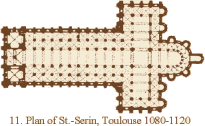
With the passing of time the church building became more elaborate and the basilicas became cathedrals. After the Byzantine period came the Medieval period and the Romanesque period. This is a jump in time of about 600 years (see figs. 11, 12).
 The most conspicuous difference between Romanesque architecture and that of the preceding centuries is the amazing increase in building activity. An eleventh century monk, Raoul Glaber, summed it up well when he triumphantly exclaimed that the world was putting on a "white mantle of churches." These churches were not only more numerous than those of the early Middle Ages, they were also generally larger, more richly articulated, and more "Roman-looking," for their
naves now had vaults instead of wooden roofs, and their exteriors… were decorated with both architectural ornament and
The most conspicuous difference between Romanesque architecture and that of the preceding centuries is the amazing increase in building activity. An eleventh century monk, Raoul Glaber, summed it up well when he triumphantly exclaimed that the world was putting on a "white mantle of churches." These churches were not only more numerous than those of the early Middle Ages, they were also generally larger, more richly articulated, and more "Roman-looking," for their
naves now had vaults instead of wooden roofs, and their exteriors… were decorated with both architectural ornament and 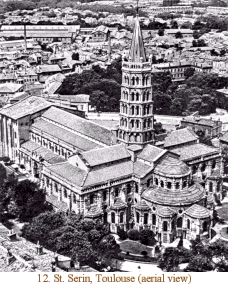 sculpture. Geographically, Romanesque monuments of the first importance are distributed over an area that might well have represented the Catholic world, from northern Spain to the Rhineland, from the Scottish-English border to central Italy. The richest crop, the greatest variety of regional types, and the most adventurous ideas are to be found in France. – Jansen "History of Art" (pg. 262)
For an example let's look at St.-Sernin in Toulouse France. It took 40 years to build (1080-1120). This example of Romanesque architecture is in the form of a Latin cross. It has a long nave and transept with two aisles on either side. Groin-vaults, arches, engaged columns, transverse arches, and barrel vaults support the structure. It has crypts in the west end. It also has different roof levels with a crossing tower above the intersection of the nave and transept.
|


