|
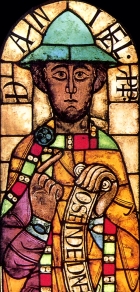
The rigid geometrics of the Byzantine period gave way to the fluid dynamism of Romanesque art, of the eleventh and twelfth centuries, encompassing the western European artistic production, especially the architecture. Romanesque Art was not a return to classical ideals, but was named for a renewed interest in Roman construction techniques. The Romanesque artists created a heightened sense of drama through a more emphatic play of gestures and swirling clothing.
The expansion of monasteries was the main force behind the unprecedented artistic and cultural activity. The new monasteries became repositories of knowledge, in Bible, in the writings of the Latin and Greek church leaders, in copied works of classical philosophers and theoreticians, and in Latin translations of Arabic treatises on mathematics and medicine. The monasteries sometimes also functioned as cathedrals, but few people outside the monasteries could read or write.
The Romanesque movement was considered an extension of divine service, as a sacrificial gift to God. This art became a vehicle for religious propaganda, to create a solemn and vague religious state of mind. It gave greater emphasis to the spiritual world, not using the laws of logic or experience, but of the inner vision. Romanesque art formulated a visual language capable of spelling out the doctrines of the Christian faith. The church buildings had a sculpted entrance to portray prophetic scenes, acting as a stern and symbolic preparation for the mystical experience to be found within the holy building. As people meandered inside the building, they would encounter other scenes from biblical history on doors, capitals, and walls.
5"And when you pray, do not be like the hypocrites, for they love to pray standing in the synagogues and on the street corners to be seen by men. I tell you the truth, they have received their reward in full. 6But when you pray, go into your room, close the door and pray to your Father, who is unseen. Then your Father, who sees what is done in secret, will reward you.
16"When you fast, do not look somber as the hypocrites do, for they disfigure their faces to show men they are fasting. I tell you the truth, they have received their reward in full. 17But when you fast, put oil on your head and wash your face, 18so that it will not be obvious to men that you are fasting, but only to your Father, who is unseen; and your Father, who sees what is done in secret, will reward you.
19"Do not store up for yourselves treasures on earth, where moth and rust destroy, and where thieves break in and steal. 20But store up for yourselves treasures in heaven, where moth and rust do not destroy, and where thieves do not break in and steal. 21For where your treasure is, there your heart will be also.
28"And why do you worry about clothes? See how the lilies of the field grow. They do not labor or spin. 29Yet I tell you that not even Solomon in all his splendor was dressed like one of these. - Matthew 6:5-6, 16-21, 28-29
In Jesus' sermon on the mount, He taught about humble worship and focusing on heaven. Is this attitude reflected in Romanesque art?
Towers
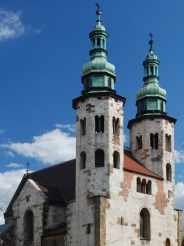
Romanesque architecture is known by its massive quality, its thick walls, round arches, sturdy piers, groin vaults, large towers and decorative arcading. Towers were an important feature of Romanesque church buildings, taking a variety of forms, square, circular and octagonal. Towers were positioned differently in relation to the church in different countries. Spain and Portugal usually have two towers at their larger church buildings. In other countries, the bigger the building the more towers they had. In Italy towers are almost always free standing and the position is often dictated by the landform of the site, rather than aesthetics. The most famous of the circular free-standing towers is the Leaning Tower of Pisa.
Later, in smaller church buildings the tower and spire was abbreviated to just a steeple.
Building Bigger
Many cities, regions, and countries built large cathedrals for both practical politics and spiritual politics. Often used to unite the people behind the king. Religious leaders would be subject to kings, so there was a mix of government with religion. Having large cathedrals created a greater illusion of divine power.

Buttresses (and flying buttresses) were used to make buildings larger by raising the ceiling and widening the nave.
|