Dating Biblical Events:
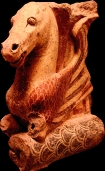 The Hyksos are credited with introducing the horse to the Egyptian army during the 14th dynasty. The first mention of a horse in the Bible is in Genesis 47:17, when the Egyptians gave horses in exchange for food during the famine. Chariots were also mentioned in Genesis 50:9. In Exodus 1:8 there was a new king who did not know of Joseph. It is probable that there was a change of powers on the throne of Egypt between Joseph and Moses. The Hyksos ruled Egypt from about 1650-1550 BC. The Nubians ruled from 732-656 BC. The Persians ruled 525-404 BC and 343-332 BC. After that Alexander the Great took control. On this basis, it is assumed Joseph was in Egypt during Hyksos rule. There were six Hyksos pharaohs, but little information has been found about any of them. The Egyptians tried to erase them from their history, making them difficult to date. One of these pharaohs names was just recently discovered inscribed on a door jamb from Tell el-Dab'a.
Studying Genesis 12:4; 21:5; 25:26; 47:28, we calculate there were 214 years between Abraham's visit to Egypt to when his descendents moved to Egypt. And based on Genesis 15:13-14, Exodus 12:40-41, and Galatians 3:16-17 the Israelites were in Egypt for 430 years. That means 214 years after Abraham went to Egypt, Joseph was there. And 430 years after that, Moses lead the people out. The problem is that most scholars place the Exodus at 1445 BC which would place Joseph in Egypt at 1875 BC, well before the Hyksos.
Trying to match up the patriarchs with the pharaohs is doubly difficult when you realize that Egyptologists disagree on the dates of the pharaohs as well. Below is a list of possible matches.
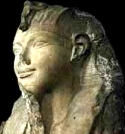
Guesses:
Most scholars think Abram visited Egypt in either the 11th or 12th dynasties, a span of 11 possible pharaohs. Amenemhat I ruled Egypt in the 12th Dynasty, and had a prosperous reign. It is possible that Abram visited Egypt during Amenemhat's reign (Genesis 12:10-20). Abram left Egypt with many possessions, livestock, and a servant named Hagar (Gen 16:1).
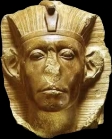
Senusret III ruled later in the 12th Dynasty and may have been the pharaoh Joseph served. The statues of Senusret during his reign depict human qualities and give a sense of age and tension, rather than the all powerful king portrayed in older works. We see in these statues a shift away from the king as god, and more towards the king as leader.

Who was the pharaoh who commanded the death of newborn Israelites when Moses was a baby? One possibility was Ahmose I, founder of the 18th Dynasty. During his reign Egypt was finally and completely liberated from the Hyksos.
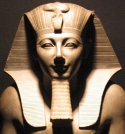
When Moses was 80, he returned to Egypt to confront the pharaoh. Who was the hard hearted leader that finally allowed the Israelites to leave? One possibility was Tuthmosis III of the 18th Dynasty. He is recorded as a great military leader.
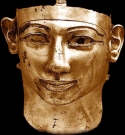
Pharaohs named in the Bible:
The first king mentioned by name is Shishaq (probably Shoshenq I), the founder of the twenty-second dynasty and contemporary of Rehoboam and Jeroboam (1 Kings 11:40; 2 Chronicles 12:2).
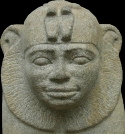
Also mentioned was Tirhakah in 2 Kings 19:9 and Isaiah 37:9. He was probably Taharqa who lead in the 25th Dynasty and one of the Nubian pharaohs, from Ethiopia.

Necho II of the 26th Dynasty killed king Josiah of Judah (2 Kings 23:29-35, 2 Chron 35:20-22; 36:3-4; Jer 46:2).
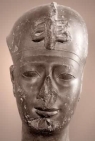
In Jeremiah 44:30, Hophra (Apries or Wahibre) was of the 26th Dynasty. He was known as a military failure.
Do the Math
So Abram left, as the LORD had told him; and Lot went with him. Abram was seventy-five years old when he set out from Haran. - Genesis 12:4, v10 (he went to Egypt)
Abraham was a hundred years old when his son Isaac was born to him. - Genesis 21:5
After this, his brother came out, with his hand grasping Esau's heel; so he was named Jacob. Isaac was sixty years old when Rebekah gave birth to them. - Genesis 25:26
Jacob lived in Egypt seventeen years, and the years of his life were a hundred and forty-seven. - Genesis 47:28
100 - 75 + 60 + 147 - 17 = 214
Can't find /home/sites/37b/b/b8d8fd9032/public_html/learning/art/records/
|