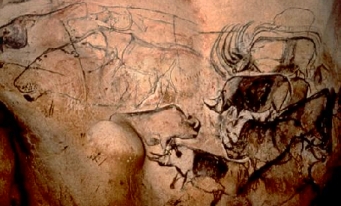
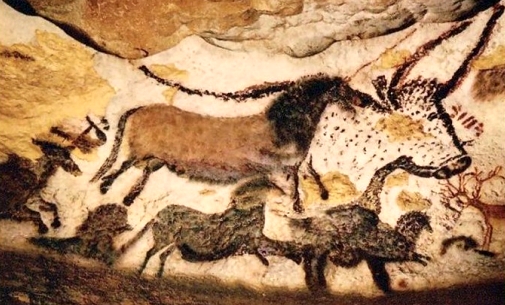
 The oldest known art is found in the caves of France, Chauvet and Lascaux. Some historians have speculated that the animal drawings were used in a ceremony to give the hunters dominance over their prey. The hunters would throw spears at the finished artwork to kill the animal's spirit. However, there are some paintings that appear to tell a story about specific events.
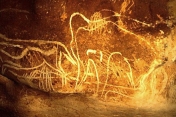 Some of the animals identified in the French caves include horses, cattle, reindeer, stags, panthers (or cheetahs), bears, bison, owls, aurochs, rhinos, mammoths (or elephants), ibex, lions, wild oxen, megaloceros and hyenas. Many of these animal are no longer common to France, which causes us to wonder what the animal world was like then. Many animals today are separated into different regions of the world.
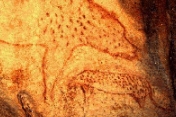 If this Paleolithic art preceded the flood, it may account for the Noah's accessibility to gather animals for the ark. If it occurred after the flood it may be a reflection of the slow dispersion of animal types. With either time placement, the cave paintings give extra validity to the Biblical story of the flood.
They had with them every wild animal according to its kind, all livestock according to their kinds, every creature that moves along the ground according to its kind and every bird according to its kind, everything with wings. Pairs of all creatures that have the breath of life in them came to Noah and entered the ark. - Genesis 7:14-15
The Epic of Gilgamesh
In tablet eleven of this oldest known pagan writing,
Utnapishtim explains that the gods decided to send a great flood. To save Utnapishtim the god Ea told him to build a boat. He gave him precise dimensions, and it was sealed with pitch and bitumen. His entire family went aboard together with his craftsmen and "all the animals of the field." A violent storm then arose which caused the terrified gods to retreat to the heavens. Ishtar lamented the wholesale destruction of humanity, and the other gods wept beside her. The storm lasted six days and nights, after which "all the human beings turned to clay." Utnapishtim weeps when he sees the destruction. His boat lodges on a mountain, and he releases a dove, a swallow, and a raven. When the raven fails to return, he opens the ark and frees its inhabitants. Utnapishtim offers a sacrifice to the gods, who smell the sweet savor and gather around. Ishtar vows that just as she will never forget the brilliant necklace that hangs around her neck, she will always remember this time.
Why is this writing important to us? Some scoffers say that Moses copied the flood account from Mesopotamian mythology. According to apologeticspress.com, there are over 200 various flood accounts scattered all over the world in various cultures including the Aztecs and Chinese. All of these accounts prove the existence of a worldwide flood. Being older than Genesis does not prove it is correct, but rather supportive. All of these cultures with stories about the flood, passed the story down from generation to generation. It is natural for the story to change some through the years. However, with Moses, he had a direct connection with the true source of the flood.
|