| Amaunet | A female counterpart to Amon and one of the primordial gods of the Hermopolitian Ogdoad (group of eight gods). She was also worshipped at Thebes along with Amon and Mut. Goddess of invisibility and snakes. |
| Ammit | Deity who consumes those who fail to pass the 'weighing of the heart' in the underworld judgment ceremony. |
| Amon (Amun) | Usually associated with the wind, or things hidden, mosquitoes, and was also of the Hermopolitian Ogdoad. He became Amon-Re, king of the gods. He was part of the Theban Triad, along with Mut and Khonsu. |
| Antaios | He was originally a double god, "the two falcons", that was later joined to create one, probably that of Horus. |
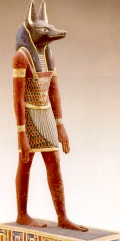
| Anubis | God of the dead and of embalming. |
| Anuket | She was associated with the gazelle. |
| Apis | Seen as the bull with a solar disk between its horns, Apis was associated with Osiris and Ptah. |
| Aton (Aten) | The solar disk |
| Atum | A primordial god that was represented in the form of a human and a serpent. He was the supreme god in the Heliopolitan Ennead (group of nine gods) and formed with Re to create Re-Atum. |
| Bastet | Goddess of cats and perfume |
| Bes | Home protector god. Patron god of childbirth. |
| Geb | God of the Earth, father of Osiris, Isis, Nephthys and Set. |
| Hapi | The "spirit of the Nile" and the rising waters of the Nun (source of all life). |
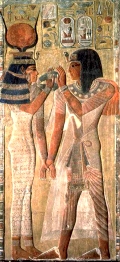
| Hathor | The goddess of love, dance and alcohol was depicted as a cow. She was also the goddess of the dead. She was worshipped as the consort of Horus and Edfu, and was associated with Isis at Byblos. |
| Hauhet | Goddess of infinity and snakes |
| Heqet | The frog goddess, often shown as a frog-headed woman or as a frog. Because the Egyptians saw that there were many frogs, all appearing from the Nile, they associated the frog with fertility and resurrection. |
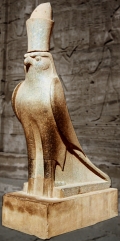
| Horus | The earliest royal god was the shape of a falcon, with the sun and moon as his eyes. The sky-god was the ruler of the day. The many forms of Horus are; Re-Harakhti, Harsiesis, Haroeris, Harendotes, Khenti-irti, Khentekhtay (the crocodile-god), and Harmakhis, which is Horus on the horizons, in which the Sphinx of Giza is considered to be his aspect. |
| Imhotep | God of wisdom, medicine and magic |
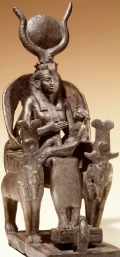
| Isis | Protective goddess. The mother of Horus and sister and consort of Osiris. Associated with Astarte, Hathor, Nut and Sothis, she was later worshipped over the entire Roman Empire. She is called the great enchantress because she has magic powers, is the goddess of medicine, and taught the people how to farm. |
| Kauket | Goddess of darkness, and snakes |
| Khnum | Resembling a human with a rams head. |
| Khonsu | The moon god was the son of Amon and Mut. |
| Meretseger | Goddess of the valley of the kings. |
| Min | God of fertility coalesced with Amon and Horus. |
| Mut | Mother and creator goddess. She was a consort of Amon and part of the Theban Triad (group of three gods). |
| Naunet | Goddess of the watery abyss and snakes. |
| Nephthys | Goddess of the dead, wife of Set. |
| Nun | God of the primal waters. Nun was a mass of stagnant water which filled all the universe. |
| Nut | Mother of the sun, moon, sky and heavenly bodies. |
| Osiris | He is regarded as the dead king that watches over the nether world and is rejuvenated in his son Horus. The symbol of eternal life. |
| Ptah | God of craftsmen. He coalesced with Sokaris and Osiris. |
| Re (Ra) | He was the sun god. From the fifth Dynasty onwards he becomes a national god and is combined with the supreme deity Amon. |
| Reshep | War god that was originally from Syria. |
| Serapis | He was later worshipped by the Greeks as Zeus. |
| Seker | A god of light, protector of the spirits of the dead passing through the Underworld en route to the afterlife. |
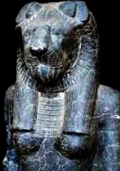
| Sekhmet | She was part of the Memphite Triad with Ptah and Nefertem. She was the goddess of war and sickness. |
| Seshat | Scribe goddess. |
| Seth (Set) | The son of Geb and Nut in the Heliopolitan Ennead was in the form of an animal that has no zoological equivalent. This powerful god was regarded as god of the desert, making him a god of foreign lands. |
| Shu | He was an ancient cosmic power and was regarded as the god of the air and the bearer of heaven. Father of Geb and Nut. |
| Sobek | He was a crocodile god. During the middle Kingdom he coalesced with Re, Sobek-Re, and was worshipped as primordial deity and creator-god. |
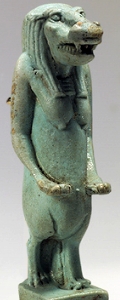
| Taweret (Tauret) | Hippopotamus goddess of childbirth, mothers and children. |
| Tefnut | Goddess of moisture and mother of Geb and Nut. |
| Thoth | He was worshipped as a baboon. He was the god of sacred writings, scribes, magic and wisdom. |
| Wadjet | Snake goddess of lower Egypt. |
| Wepwawet | Jackal god of upper Egypt, the opener of the ways. |
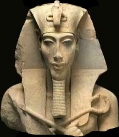
At one point of Egypt's history, it was monotheistic (1343-1332 BC). Under the reign of Akhenaten (Amenhotep IV), Egypt focused on the sun deity Aten. Akhenaten was the son of Amenhotep III and Queen Tiy, a descendent of a Hebrew tribe. The religious change survived only until the death of Akhenaten, and the old religion was quickly restored during the reign of Tutankhamun.
Can't find /home/sites/37b/b/b8d8fd9032/public_html/learning/art/records/