|
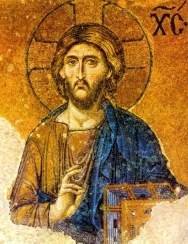
In 323 Emperor Constantine moved the capitol of the Roman Empire to Byzantium. It was then renamed Constantinople. The Byzantium Empire (Eastern section) stayed intact over a thousand years till the fall of Constantinople in 1453 to the Turks. The development of the style of Byzantine Art was developed during the fifth and sixth centuries.
Byzantine art never lost sight of its classical Greek heritage, but was distinguished from it in a number of ways. The most profound of these was that the humanist ethic of Ancient Greek art was replaced by a Christian ethic. Where classical art was the glorification of man, Byzantine art was the "glorification of God." Classical artistic tradition of depicting nude figures was banished. Christian morals replaced the classical preoccupation with human body. The figures of God the Father, Jesus Christ, and the saints and martyrs of Christian tradition were elevated, and became the dominant, almost exclusive, focus of Byzantine art. This brought about the icon, the most important form of Byzantine art. The icon served as a link to God to mediate prayers, hymns, and sermons in form and color. Rather than using art as pagan idols or for personal vanity and sensual pleasure, as the ancients had done, the Byzantine artists sought to depict the inner or spiritual nature. To this end simplification and stylization were perfectly acceptable. Certain artistic traditions that originated in the Byzantine Empire, particularly in regard to icon painting and church architecture, are maintained in Greece, Russia and other Eastern Orthodox countries to the present day.
It is interesting that we have drawings, paintings, and sculptures of important people during the time of Jesus, but none of Him. Why is that? Was that part of God's plan? Consider what Isaiah prophesied about Jesus in Isaiah 53:2, "He grew up before him like a tender shoot, and like a root out of dry ground. He had no beauty or majesty to attract us to him, nothing in his appearance that we should desire him." In our worship we are to pray through the image of God, but that is not something made by our hands, it is Jesus himself (2 Cor 4:4; Col 1:15; 3:10).
Physical Characteristics
| Esau | red and hairy (Gen 25:25) |
| Rachel | lovely and beautiful (Gen 29:17) |
| Leah | weak eyes (Gen 29:17) |
| Moses | skin glowed (Ex 34:28,35) |
| Eglon | very fat (Jud 3:17) |
| Ehud | left handed (Jud 3:15,21)) |
| Samson | long hair (Jud 16:13-14) |
| David | ruddy and handsome (1 Sam 17:42) |
| A giant | 6 fingers on each hand and 6 toes on each foot (1 Sam 21:20) |
| An Egyptian | 7 ˝ feet tall (1 Chron 11:23) |
| Solomon's wife | very descriptive (Song of Solomon) |
| Solomon | radiant, ruddy, very black wavy hair (Song of Solomon 5:10-11) |
| Elisha | bald (1 Kings 2:23) |
| Zacchaeus | short (Luke 19:3) |
Consider what Isaiah prophesied about Jesus… Other people are defined by certain looks in the Bible, but not Jesus. Why is that?
The god of this age has blinded the minds of unbelievers, so that they cannot see the light of the gospel of the glory of Christ, who is the image of God. - 2 Corinthians 4:4
He is the image of the invisible God, the firstborn over all creation.
…and have put on the new self, which is being renewed in knowledge in the image of its Creator. - Colossians 1:15; 3:10
In our worship, we are to pray through the image of God, but that is not something made by our hands, it is Jesus himself.
We are identified to His inward beauty, not His external nature.
Are we to know the external or internal nature of Jesus?
Is worship to be an external or internal focus?
|