|
Gothic art was the aesthetic expression of European history when pagan religions had been extinguished, the traditions of classical civilization destroyed, and the barbarians defeated, Christianized or assimilated. The Catholic Church had established itself not only as the sole spiritual power, supreme and almost unquestioned in authority, but also as the arbiter of the destinies of sovereigns and individuals.

Notre-Dame Cathedral, Paris, France
The "Holy" Roman Empire, under the direction of the pope through the monastic orders, attempted to politically restore a sense of nationality by means of a creative civilization. They created a religious enthusiasm that clamored for artistic expression and turned attention from decoration to plan, form, and construction. The beginnings of the Gothic art signaled the triumph of Catholic Christianity.
Gothic art told a narrative story through pictures, both Christian and secular. The earliest Gothic art was Christian sculptures on the walls of Cathedrals and abbeys. Christian art was often typological in nature, showing the stories of the New Testament and the Old Testament side by side. Saints' lives were often depicted. Images of the Virgin Mary changed from the Byzantine iconic form to a more human and affectionate mother, cuddling her infant, and showing the refined manners of a well-born aristocratic courtly lady.
Gothic sculpture evolved from the early stiff and elongated style, still partly Romanesque, into a spatial and naturalistic feel in the late 12th and early 13th century. Influences from surviving ancient Greek and Roman sculptures were incorporated into the treatment of drapery, facial expression and pose.
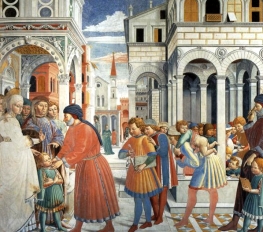
Frescoes continued to be used as the main pictorial narrative craft on church walls in southern Europe as a continuation of early Christian and Romanesque traditions. In the north stained glass was the art of choice until the 15th century.
20Our fathers worshiped on this mountain, but you Jews claim that the place where we must worship is in Jerusalem."
21Jesus declared, "Believe me, woman, a time is coming when you will worship the Father neither on this mountain nor in Jerusalem. 22You Samaritans worship what you do not know; we worship what we do know, for salvation is from the Jews. 23Yet a time is coming and has now come when the true worshipers will worship the Father in spirit and truth, for they are the kind of worshipers the Father seeks. 24God is spirit, and his worshipers must worship in spirit and in truth." - John 4:20-24
Jesus taught that the location was not important for worship, rather our attitude.
|