|
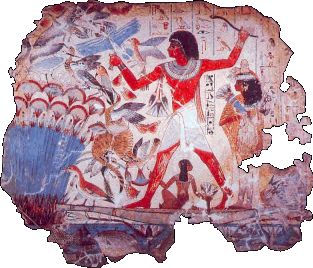
In Egyptian paintings or reliefs (wall carvings), the head of a person was always shown in profile (there are very few exceptions to this rule). The eye was, however, shown as if seen from the front.
The reason for this was that the Egyptians represented human figures as stiff (a symbol of authority) composite pictures, with different parts of the body shown in their most characteristic and most easily recognizable views: the head in profile, the eye in front view, the shoulders in front view, the arms and hands in profile, the legs again in profile.
The torso is turned fully to the front, making the figure's body appear uncomfortably twisted, despite the desire to represent a strong, powerful figure.
Paintings followed a rigid formula for representing the human figure. In wall paintings, the surface is divided into horizontal bands separated by lines. The leg is turned to the same side as the head, with one foot placed in front of the other. The head is at right angles to the body. Every figure stands or sits with a formal rigid posture. These very formal and stylized rules have made Egyptian Art one of the most widely recognized forms of art in the world. Over thousands of years Egyptian artists adhered to this one style, which shows how connected art was to their religion.
Yet another convention of Egyptian art was to depict gods, including the pharaoh, and other important figures much larger in size than everyone else in the scene. This was a simple way to indicate status.
"Out of Egypt"
When they had gone, an angel of the Lord appeared to Joseph in a dream. "Get up," he said, "take the child and his mother and escape to Egypt. Stay there until I tell you, for Herod is going to search for the child to kill him." So he got up, took the child and his mother during the night and left for Egypt, where he stayed until the death of Herod. And so was fulfilled what the Lord had said through the prophet: "Out of Egypt I called my son.
- Matthew 2:13-15
We don't know how long Jesus was in Egypt. Some think he was in Alexandria since many Jews lived there at that time. It had the greatest library in the world at that time.
The phrase "out of Egypt" occurs 111 times in the Bible. 50 of those occurrences are in the books of Moses.
What was he trying to tell the people?
What was he reminding them of?
Why did Matthew use that passage from Hosea 11 to relate to Jesus?
The church is a called out people (ecclesia). Called out of slavery of sin and death.
The Jews were constantly thinking of what they left and often desired to return. We may have the same struggles with our own Egypt.
Can't find /home/sites/37b/b/b8d8fd9032/public_html/learning/art/records/
|