|
The earliest form of art has been found to be cave paintings. Their age is questionable because carbon dating is only reliable if we have actual dated objects for collaboration. We just call the art pre-historic.
We don't see the use of caves in the Bible until after the flood, but that doesn't rule out their use from the beginning. We see Biblical examples of caves being used for housing.
Lot and his two daughters left Zoar and settled in the mountains, for he was afraid to stay in Zoar. He and his two daughters lived in a cave. - Genesis 19:30
Because the power of Midian was so oppressive, the Israelites prepared shelters for themselves in mountain clefts, caves and strongholds. - Judges 6:2
He attacked them viciously and slaughtered many of them. Then he went down and stayed in a cave in the rock of Etam... Then three thousand men from Judah went down to the cave in the rock of Etam... - Judges 15:8,11a
We also read about caves being used as hiding places. Elijah and Obadiah hid 100 men in a cave (1 Kings 18:13), and David and his army hid in a cave (1 Samuel 24). Job refers to outcasts living in caves (Job 30:3-8).
16Now the five kings had fled and hidden in the cave at Makkedah. 17When Joshua was told that the five kings had been found hiding in the cave at Makkedah, 18he said, "Roll large rocks up to the mouth of the cave, and post some men there to guard it... 22Joshua said, "Open the mouth of the cave and bring those five kings out to me." 23So they brought the five kings out of the cave-the kings of Jerusalem, Hebron, Jarmuth, Lachish and Eglon... 26Then Joshua struck and killed the kings and hung them on five trees, and they were left hanging on the trees until evening. 27At sunset Joshua gave the order and they took them down from the trees and threw them into the cave where they had been hiding. At the mouth of the cave they placed large rocks, which are there to this day. - Joshua 10:16-18,22-23,26-27
In this case, the hiding place became their tomb as well. Caves were the graves for others as well, including Abraham, Isaac, Ishmael (Genesis 25:9), Sarah (Genesis 23), Jacob, Rebecca, and Leah (Genesis 49:29ff). They were all buried in the cave Machpelah. Caves were also used in the first century for burial as well, as in the example of Lazarus (John 11).
Many consider caves to be the womb of the earth. And many are returning to cave-like dwellings. Caves have the advantage of maintaining a more constant temperature year round. Architects are utilizing this feature in underground homes as well as cellars. Because of this consistency, it is also beneficial in preserving art. That may be why some of the oldest known art work has been found in caves.
It is also interesting to note the quality of the oldest works of art. The detail and technique is advanced, unlike the work of a child. This does not support the image of the club toting, grunting cave man that science likes to portray.
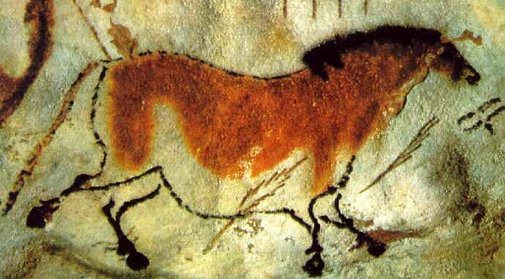
How primitive was primitive man?
Genesis 4:16-22 describes Cain and his descendents building a city, living in tents, raising livestock, playing harps and flutes, and forging tools out of bronze and iron. Not primitive! Would you say the cave paintings show an intelligent man?
After leaving the Lascaux cave Pablo Picasso said,
"We have learned nothing in twelve
thousand years."
|