|
In our first lesson we see how we were created in the Creator's image. We were created to be creative.
Mankind has always struggled with this nature.
In Mesopotamian Art, we will discover how this confusion caused man to use art as a form of power. They used it in an attempt to create a bridge between man and supernatural power. They used art to create images to be worshipped. They used it to intimidate others.
They saw something divine in art but they did not understand it.
Architecture
A ziggurat, meaning "to build on a raised area," is a temple tower common to the Sumerians, Babylonians and Assyrians of ancient Mesopotamia. Ziggurats are built in tiers sloping inward upon a rectangular platform, and are pyramidal structures. There is a staircase connecting all the levels. Sun-baked bricks made up the core of the ziggurat with facings of fired bricks on the outside. The facings were often glazed in different colors. The Tower of Babel was most likely a ziggurat.
 1Now the whole world had one language and a common speech. 2As men moved eastward, they found a plain in Shinar and settled there.
3They said to each other, "Come, let's make bricks and bake them thoroughly." They used brick instead of stone, and tar for mortar. 4Then they said, "Come, let us build ourselves a city, with a tower that reaches to the heavens, so that we may make a name for ourselves and not be scattered over the face of the whole earth."
5But the LORD came down to see the city and the tower that the men were building. 6The LORD said, "If as one people speaking the same language they have begun to do this, then nothing they plan to do will be impossible for them. 7Come, let us go down and confuse their language so they will not understand each other."
8So the LORD scattered them from there over all the earth, and they stopped building the city. 9That is why it was called Babel -because there the LORD confused the language of the whole world. From there the LORD scattered them over the face of the whole earth. - Genesis 11:1-9
Historians are not sure of the function of ziggurats. Some think they were considered the home of a god. Others think they were the burial place of a king or god. And others think it was a place of worship and ceremonies. These mountain-like structures might represent a connection between heaven and earth. The great staircase allows the gods to descend from heaven to earth.
Babel actually means "gate of God" and Babylon means "gate of the god." Babel also means a confusion of voices and other sounds. And babble means a gibberish resembling the sounds of a baby. So which definition came first? Was the tower called Babel before God confused the language or after?
Some scholars believe the Ziggurat of Marduk was the Biblical tower of Babel. Marduk (Bel or Baal) was the national god of Babylonia. He began as a god of thunderstorms, and according to legend he became lord of all the gods.
In all, there are 25 remaining Mesopotamian ziggurats. Another one is the White Temple of Uruk (Erech). It is also known as the Temple of Anu, the sky god. Both Babel (Babylon) and Erech are mentioned in Gen 10:10. The interesting thing about Erech (Uruk) is it is home to king Gilgamesh of the oldest known writing, the Epic of Gilgamesh (about 2000 BC). This Sumerian writing recounts the story of the flood and also refers to God as Huwawa, which sounds close to the Hebrew word YaHWeH. Some scholars think Gilgamesh may have been Nimrod.
He was a mighty hunter before the LORD; therefore it is said, "Like Nimrod a mighty hunter before the LORD." The beginning of his kingdom was Babel and Erech and Accad and Calneh, in the land of Shinar. - Genesis 10:9-10
Some people may read Genesis 11 and think the people were wanting to get closer to God. But if this was a Mesopotamian ziggurat it was probably an act of idolatry. There was probably at this time a single world religion which didn't worship the true God. God did not mix the languages to cause confusion, but to guide the people toward Him. To trust not in themselves, but to trust in God.
This is what the LORD says:
5"Cursed is the one who trusts in man,
who depends on flesh for his strength
and whose heart turns away from the LORD.
6He will be like a bush in the wastelands;
he will not see prosperity when it comes.
He will dwell in the parched places of the desert,
in a salt land where no one lives.
7"But blessed is the man who trusts in the LORD,
whose confidence is in him.
8He will be like a tree planted by the water
that sends out its roots by the stream.
It does not fear when heat comes;
its leaves are always green.
It has no worries in a year of drought
and never fails to bear fruit." - Jeremiah 17:5-8
Could Jeremiah be referencing the ruins of Babel wasting away in the desert? (Note: This passage has similarities to Psalm 1.)
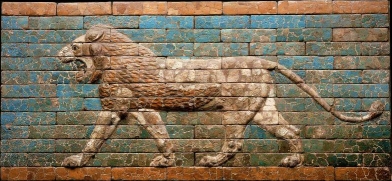
Glazed brick panel from the processional way at Babylon
|